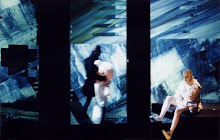
This is a very basic test using still images in After-Effects in a 3D space; some of the images have been distorted to create a false perspective, which is revealed through the camera movement. Note: the use of these particular images from a group of industrial buildings is only chosen to test the technique; there is no intention to use them in the film. (00:00:10)
Friday, 5 February 2010

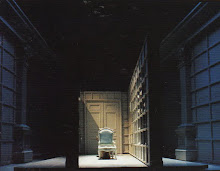
Andrea Palladio, Proscenium of the Teatro Olimpico, Vicenza, Italy, 1584


Instead of painting the design on canvas, as usually done for theatre props, Palladio designed the stage built of wood and plaster, using spatial techniques to manipulate and exaggerate the perspective. The section helps to understand how it is done.A similar technique will be used in the form of moving image, where only the movement through the space will reveal the montage.
Idea for Project 003 (title to be defined)
WHAT
- Each subject hides a story; urban spaces are loaded with stories.
- Each subject hides a story; urban spaces are loaded with stories.
- Spaces of transition or non-places in an urban environment are anonymous; they are used and then abandoned.
- The non-place holds multiple narratives but also reflects social interaction and alienation experienced in these sorts of contemporary urban spaces.
- Imagine hidden stories and relationships that are part of an urban and social space (stories that we find in non-places) and represent them in the form of a theatrical set.
- The theatrical set holds fictional realities; in this space the subjects project an image of their otherness.
- Non-place: representation of movement and gesture; noise; presence; self.Stage space: stasis; controlled sound; absence; other.
HOW
- Find a non-place (i.e. train station) and abstract, suggest a narrative to be represented as an example.
- Find a non-place (i.e. train station) and abstract, suggest a narrative to be represented as an example.
- The starting point to set the narrative and the characters is the film ‘Last year in Marienbad’ by Alain Resnais. This is chosen because, through its apparent simple plot, it is enigmatic and baffles the viewer. The figures that appear in it ‘are trapped (…) in a world limited in space and time, which seems to begin again and again’ (Lagier, in documentary about the film).

- The narrative starts from the non-place and is projected onto the theatre set, where it is represented.
- The stage space is composed by series of theatre props in the form of successive images in different layers, to achieve depth of field. These props move, stretch, connect one scene to the next, augmenting architectural space.
- The characters within the stage are cut off from any context, they appear static-maybe (test).
- The stage set is described as a labyrinth; the motif of the labyrinth, as in the film referenced, is present throughout the setting.
- Within the stage space, the camera acts as an external character and audience simultaneously.
- Play with rhythm in the film i.e. obsessive repetitions, changes of speed, temporal clashes.
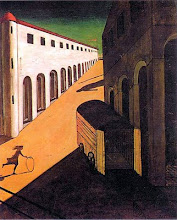
- For the stage set use false and exaggerated perspective. The first shot is static (it shows the ‘correct’ perspective); only when the camera moves through the space the montage is revealed.
Note regarding Project 003
There has been an evolution from the first idea (which dealt with the space of the subject using a membrane as an element to represent the body interlinking with its outside and inside) to the next one, which I find it to be more exciting and it has more possibilities in order to develop a set of tactics and themes beyond the master course. This idea is explained in the next post.
Monday, 1 February 2010
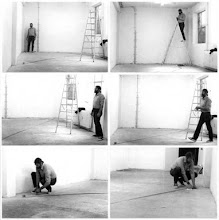
Drawing Restraint, Matthew Barney

In Drawing Restraint series, Matthew Barney uses physical obstacles and tools to complicate the process in an attempt to draw a graphic mark in an architectural space. The images produced indicate the energy used to make them and the representation of a mark. The subject uses the architectural space, takes something from it and gives something back to it, adds a mark into the space; in a way the subject appropriates and transforms the architectural space.
Dance with Camera

Bojangles of Harlem (1936)

Danse Serpentine (1896)
These two films are part of the Dance with Camera programme http://www.ubuweb.com/film/dance-with-camera.html
In Bojangles of Harlem (1936), Fred Astaire dances along with projected images of himself in the form of shadows; there are punctual interactions between the images and him. The use of the replicated images and their change of scale add dynamism to the performance; in a way the self appears dancing with his others.
In Danse Serpentine (1896) by The Lumière Brothers, the dancer performs with a voluptuous dress where coloured lights are projected. The performance acquires a particular an attractive dynamism using simple gestures.
In Bojangles of Harlem (1936), Fred Astaire dances along with projected images of himself in the form of shadows; there are punctual interactions between the images and him. The use of the replicated images and their change of scale add dynamism to the performance; in a way the self appears dancing with his others.
In Danse Serpentine (1896) by The Lumière Brothers, the dancer performs with a voluptuous dress where coloured lights are projected. The performance acquires a particular an attractive dynamism using simple gestures.
Membrane tests
Test to visualize the membrane element described previously, using a translucent balloon filled with water, to represent fluidity. (00:00:55; low resolution)
Test to explore the plasticity and elasticity of the membrane, using the same technique than before and the hand to manipulate the balloon. (00:00:32; low resolution)
Monday, 18 January 2010
Idea for Project 003

This sketch is trying to communicate the complex idea of the body interlinking with its outside and inside (understanding these concepts as I explained in ‘Notes for Project 003’) and its relation to other bodies. It represents bodies within a membrane that covers the body externally and internally; each surface of this membrane gets infected and receives impulses from both, the outside and the inside; one affects the other. This project proposes an exploration of the outside and the inside by travelling through the bodies using the membrane as the element that links them together and by building up a chain of subjects. In the sketch there are some particles that escape from the inside to the outside or the other way around. It could happen that the membranes gradually blur as we move forward through the chain.
Notes for Project 003_What I am interested in
How do we interpret the space of the subject? We could define the body (subject) as a boundary between an outside (space) and an inside (space); for now I would refer to the outside as real space and the inside as imaginary space, although this may change. How the subject, the outside and the inside interlink? What happens when the boundary merges, blurs, multiplies? What if the subject fuses with the space? Within the social field subjects relate to each other; different subjectivities have different spaces; if we can say that subjects share an outside space, is there an inside space a group of subjects can share as well?
My intention is not to propose an enclosed model, but a framework for the space of the subject or group of subjects, and to represent this.
When I mention the space of the subject here I don’t refer particularly to the space that has to do with sorts of behaviours socially and culturally formed; I refer to the spaces that we perceive, read, explore, experience, practice, represent, draw, imagine: particularly the architectural space and imaginary space in a socio-cultural context; “…evidence of its [space] existence stares us in the face: our senses and our thoughts apprehend nothing else. “ (Henri Lefebvre, The Production of Space: 12)
My intention is not to propose an enclosed model, but a framework for the space of the subject or group of subjects, and to represent this.
When I mention the space of the subject here I don’t refer particularly to the space that has to do with sorts of behaviours socially and culturally formed; I refer to the spaces that we perceive, read, explore, experience, practice, represent, draw, imagine: particularly the architectural space and imaginary space in a socio-cultural context; “…evidence of its [space] existence stares us in the face: our senses and our thoughts apprehend nothing else. “ (Henri Lefebvre, The Production of Space: 12)
Friday, 15 January 2010
John Cage's HPSCHD at Macba
This video was recorded in the John Cage's exhibition at Macba. It is one of the installations featured in the exhibition; HPSCHD. I have posted it as a reminder of the pleasure experienced in that room.
"HPSCHD, a collaboration between John Cage and Lejaren Hiller, first performed on May 16, 1969 at the University of Illinois at Urbana-Champaign, called for 7 harpsichords playing randomly-processed music by Mozart and other composers, 51 tapes of computer-generated sounds, approximately 5,000 slides of abstract designs and space exploration, and several films, all of which were performed or presented simultaneously in an asynchronous and exuberant anarchy of activity."
http://www.macba.es/controller.php?p_action=show_page&pagina_id=34&inst_id=25201
"HPSCHD, a collaboration between John Cage and Lejaren Hiller, first performed on May 16, 1969 at the University of Illinois at Urbana-Champaign, called for 7 harpsichords playing randomly-processed music by Mozart and other composers, 51 tapes of computer-generated sounds, approximately 5,000 slides of abstract designs and space exploration, and several films, all of which were performed or presented simultaneously in an asynchronous and exuberant anarchy of activity."
http://www.macba.es/controller.php?p_action=show_page&pagina_id=34&inst_id=25201
Subscribe to:
Posts (Atom)